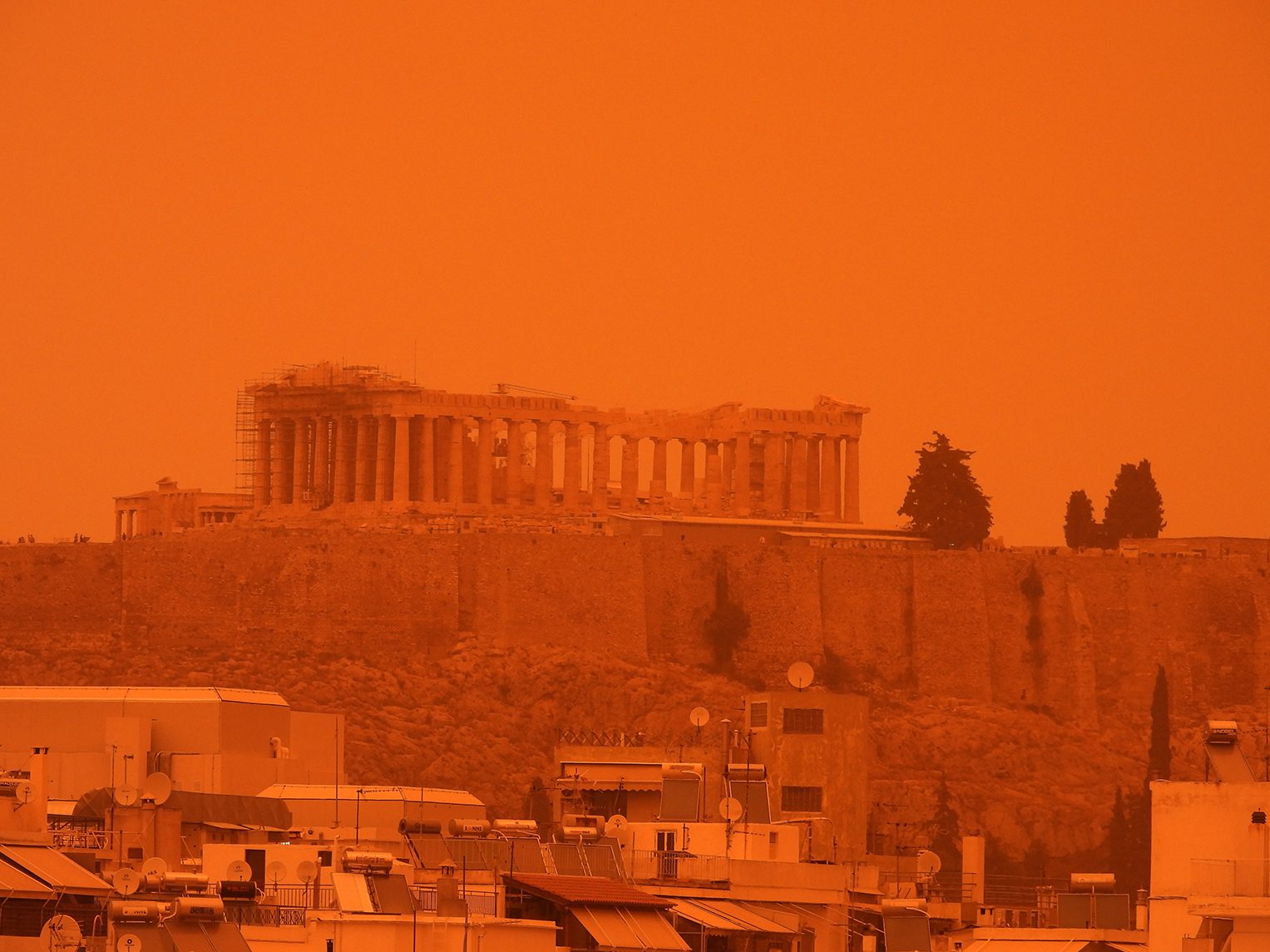
Yesterday, powerful southerly winds transported clouds of Sahara desert dust, shrouding a large portion of the country’s sky and creating an oppressive atmosphere, particularly challenging for individuals with respiratory issues.
According to meteorologist Thodoris Kolidas, this event signifies the most concentrated dust phenomenon in the country since March 2018 in Crete, with Kalamata registering the highest concentration this time. The phenomenon has begun to dissipate gradually since this morning.
During Athens’ peak periods, the health-detrimental PM10 microparticles transported by dust remained relatively low.
In 2024, Greece experienced its third encounter with dust, following occurrences at the end of March and the beginning of April. During these events, dust even reached Switzerland and southern France. The Sahara desert releases between 60 and 200 million tons of dust each year. While the larger particles settle back to Earth within the desert, the smaller ones embark on journeys spanning thousands of kilometers, sometimes reaching Europe.
According to a report by “Kathimerini,” the estimated number of dust-related deaths in Europe annually is projected to reach 42,000. In the Mediterranean region, it’s estimated that 27-44% of deaths linked to PM10 particles are attributable to African dust.
Regarding the potential increase of African dust movement phenomena in the future, Nikos Michalopoulos, Director of Research at the National Observatory of Athens, informed “K” that these occurrences have remained relatively stable over the past 20 years, impacting the country for 9-30 days each time. However, he noted that this situation might change if climate change creates new desertification areas.


 What is fyi.news?